Sauvignon Blanc has earned its place in the (all-year-round) wine calendar, and is embraced by producers and wine drinkers alike. It’s one that reinforces the cultivar’s growing significance in South Africa and abroad. Sauvignon Blanc has moved well beyond its long-held reputation as a simple summer refresher to become one of the country’s most commercially important and stylistically versatile wines.
Just two years ago, Sauvignon Blanc was South Africa’s largest single export cultivar, with 63.3 million litres shipped, up 5% year on year. Over the same period, the country’s overall wine export value rose by 4% to US$562 million despite broadly flat volumes, suggesting a category that continues to gain traction in scale and value.
The varietal has become one of the clearest expressions of what South Africa does particularly well and speaks to freshness, diversity and a strong sense of place. According to Sauvignon Blanc South Africa’s latest industry snapshot, the variety recorded the highest domestic sales volume at 15.3 million litres, while also retaining its position as the country’s leading export varietal. It also remains one of the country’s most established vineyard plantings, with SAWIS reporting 10 184 hectares under Sauvignon Blanc by the end of 2024.
Part of its strength lies in the fact that our Sauvignon Blanc cannot be reduced to a single style. The South African Sauvignon Blanc aroma wheel, which identifies 72 distinct flavour descriptors, points to just how broad the category has become. That stylistic breadth is one of the country’s greatest competitive advantages internationally. South African Sauvignon Blanc continues to perform strongly in markets such as the UK, Germany, Canada, the USA and France, giving it a foothold in mature and premium-conscious export environments. Globally, Sauvignon Blanc is planted across 121 000 hectares, with South Africa accounting for roughly 8% of that footprint.
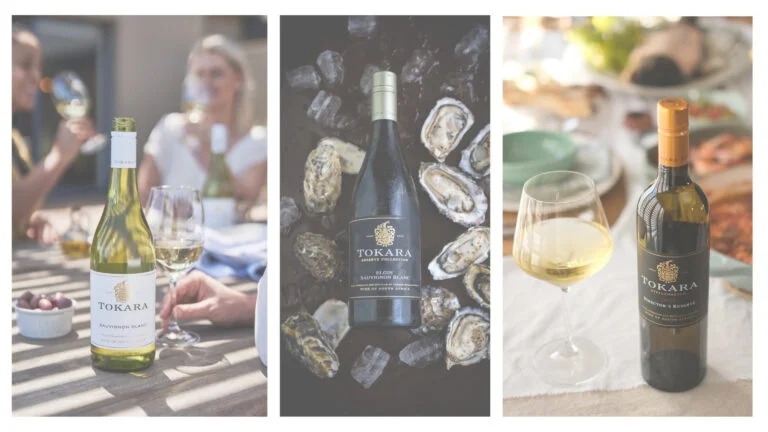
Tokara offers a strong example of how that distinctiveness is built. The Stellenbosch estate’s Sauvignon Blanc portfolio spans three tiers: its premium Sauvignon Blanc, the Reserve Collection Elgin Sauvignon Blanc, and the Director’s Reserve White blend. The premium wine draws fruit from Stellenbosch and Elgin, with hand-harvested grapes sourced from vineyards cropping between 6 and 10 tonnes per hectare. The resulting style is shaped by cool, maritime-influenced sites and a production approach that prioritises clarity and freshness.
The estate’s Reserve Collection adds another layer to that regional story. The Elgin Sauvignon Blanc is produced from top-performing blocks on Tokara’s Highlands farm, while the Director’s Reserve White, a Sauvignon Blanc–Semillon blend, comes from the highest slopes of the Stellenbosch property. Together, the wines illustrate why South African Sauvignon Blanc remains so compelling in an international context. It can be bright and immediate, but equally layered and age-worthy, all while retaining freshness and identity. This reflects the estate’s broader philosophy where climate, geography and soils combine to shape wines with a strong sense of place.
That is also why Sauvignon Blanc deserves to be celebrated across every season, not only in summer. Its range extends well beyond crisp warm-weather drinking. For instance, a wooded Sauvignon Blanc is often recommended as a fitting winter pairing with Cape Malay curry. This goes to show that the category’s real strength lies in its adaptability. South Africa has every reason to be proud of that. Its Sauvignon Blanc is not trying to emulate a single international benchmark. It succeeds because it can be coastal or inland, brisk or textured, early-drinking or cellar-worthy, while remaining recognisably South African.